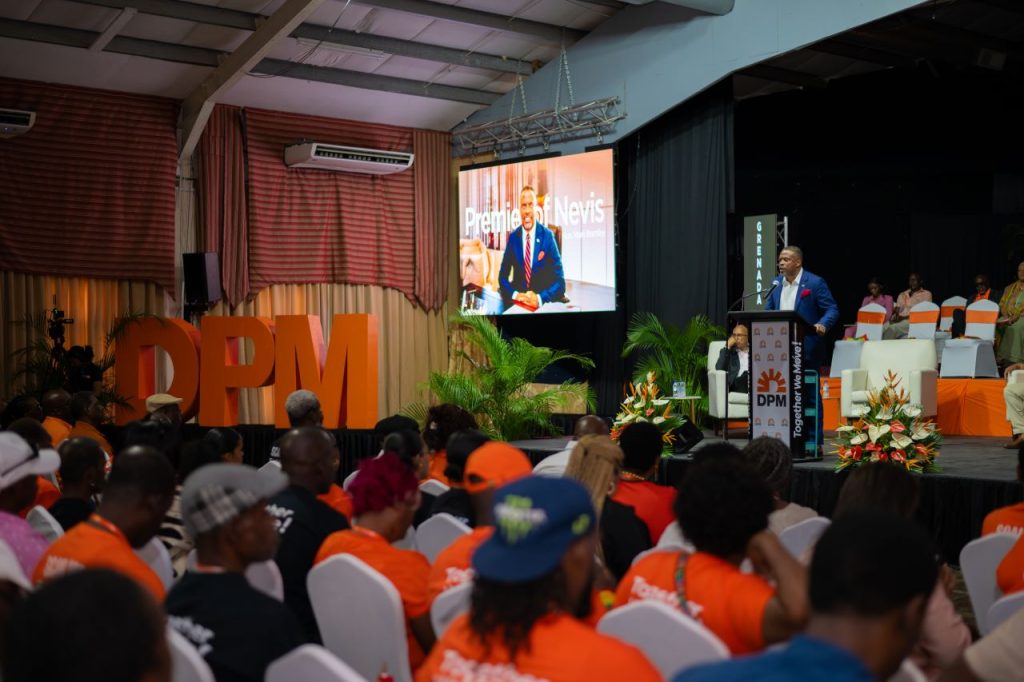
Nevis Premier Mark Brantley Delivers Keynote Address at the Inaugural Congress of Grenada’s Democratic Peoples Movement
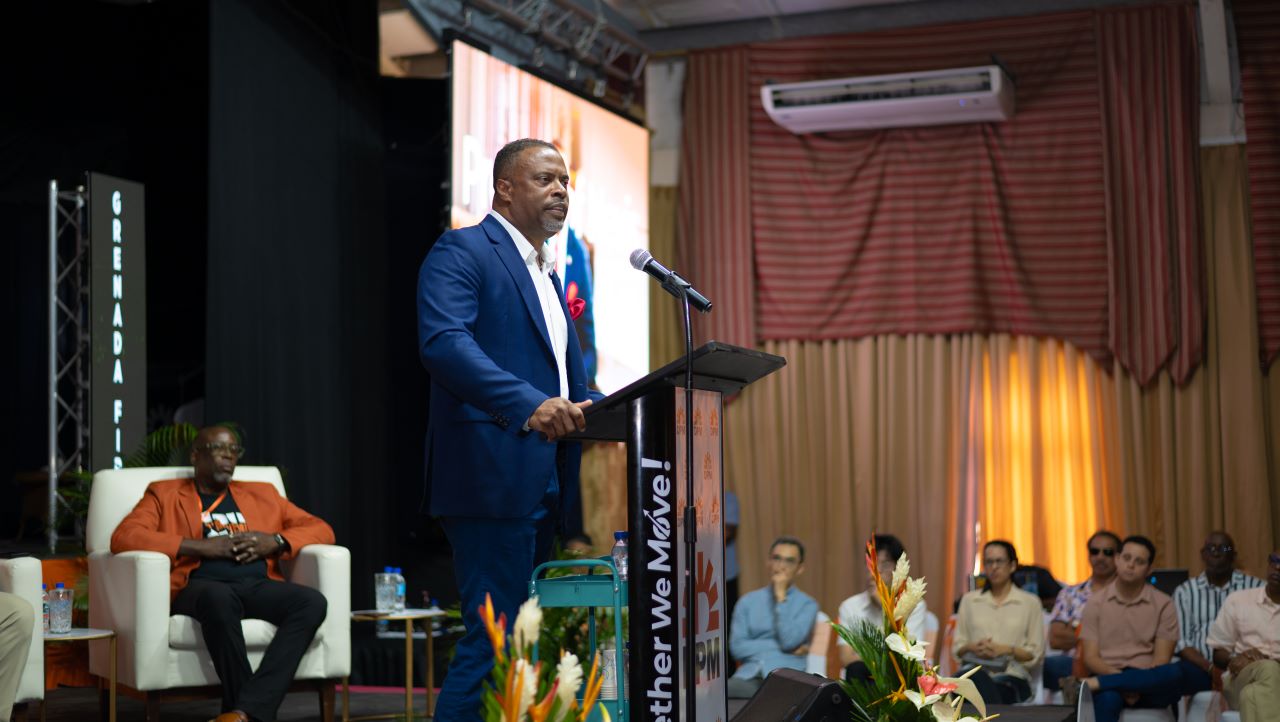
Nevis Premier Mark Brantley Delivers Keynote Address at the Inaugural Congress of Grenada’s Democratic Peoples Movement (DPM) held in Morne Rouge, Grenada on March 22, 2026
The Caribbean Must Save Itself
Let me start by saying that it is good to be home in Grenada. My wife of 32 years is from L’Anse Aux Epines and I have been coming here since 1989 when I first met her. I fell in love with her and with Grenada nearly four decades ago. And while I do not yet have a Grenadian passport, I remain hopeful.
It’s truly an honour to address the inaugural Congress of the Democratic People’s Movement and I commend Party Leader my brother the Honourable Peter David and the entire team for taking this bold step in the service of the people of Grenada Carriacou and Petite Martinique.
As a rule I try to avoid the internal politics in our sister States within the Caribbean region, and especially here in Grenada where I know and count as friends people on all sides of the political spectrum. I however could not say no to my brother Peter and to make it worse he selected my dear friend Jasmine Redhead to contact me to seal the deal. Jasmine, you see, was the one who first introduced me to the woman who is now my wife many years ago at the Cave Hill Campus of the University of the West Indies so I owe her a debt that cannot be repaid. I suspect Peter has already shown his skill at political strategy by tasking Jasmine with getting me to Grenada today. I thank Derrick James, General Secretary for the formal invitation that followed and I express sincere gratitude to the leadership and membership of the Democratic People’s Movement for the warm Spice Island hospitality extended to me thus far.
Brothers and sisters, it must be clear to us all that we live in an increasingly volatile and unpredictable world. Our region, long regarded as a Zone of Peace, saw in 2026 US warships assembled in the Southern Caribbean Sea and the invasion and abduction of a sitting President in Venezuela. Barely weeks later we have seen Iran attacked pre-emptively without regard to the United Nations or the rules of international law. Iran for its part has escalated the conflict significantly by striking important infrastructure in the Gulf States and by effectively closing the critical artery for trade, the Strait of Hormuz. The attendant consequences on the cost of fuel, the cost of shipping, the cost of insurance and the overall cost of living will impact the open economies of Grenada and the rest of the Caribbean severely. The single mother in Grenville, the elderly man in River Road and those who are already struggling to make ends meet will be hardest hit by increases in the cost of living. When energy prices rise, everything else rises from the cost of electricity to the cost of bus fare to the cost of a loaf of bread. Every household now in Grenada and across the Caribbean will be forced to cash a cheque it did not write.
As we gather here in Grenada today yet another crisis is unfolding in Cuba as the US escalates efforts to topple the Cuban regime by starving the country of much needed oil. Already there are reports of national blackouts and food shortages. Cuba is home to over 11 million people. A crisis there can destabilize the entire region especially the northern Caribbean as Cubans flee their country.
Canadian Prime Minister Mark Carney, speaking recently at the 2026 World Economic Forum in Davo,s pronounced the death of the rules-based international order. Those sentiments have been echoed by German Chancellor Friedrich Merz at the Munich Security Summit 2026. Chancellor Merz has said that the rules-based order “no longer exists” and that Europe must recognize the “new reality”.
If these sentiments are true then it would mean that in just over one year the policy prescriptions of the Trump Administration have dismantled an international rules-based system that has guided multilateral engagements since the Second Great War.
Prime Minister Carney has urged countries to acknowledge this reality and to build new cooperative frameworks among nations that can better protect their interests in a world of great-power competition. In short, he is calling for a coalition of the willing.
Canada and Germany are understanding that a new reality of global affairs is taking over where power and military might, not rules, are to be preferred as the currency of international engagement. I concede that some may argue that power has always been the currency of international engagement. Whilst that may be so, the established rules-based system acted as a check on the abuse of such power. I believe it to be true that barring international rules, we return to the law of the jungle where only the powerful survive and there are no protections for the weak and the vulnerable.
The rules of international engagement are what have allowed small developing Nations in the Caribbean and around the world to have a voice in shaping international norms. Those rules allowed us the opportunity, whether at the United Nations or elsewhere, to sound our voices and in so doing influence global change. I mention Climate Change as one such issue where the Caribbean leveraged its membership in every multilateral organization to force that issue to the forefront of the world’s consciousness. My question then is simple: what happens to the Caribbean if the rules are dismantled and multilateralism loses its place in the world?
If Canada and Germany are describing themselves as “Middle Powers” in a new world of “Great Power” competition, then I ask the obvious question: what of the other category of Nations in which the Caribbean finds itself- “The Presumed Powerless”? If the US, China and Russia are to be seen as the “Great Powers” and Canada and Europe as “Middle Powers” then it is my suggestion that the large number of others can constitute the “Power of the Collective” and must seek to do exactly as Prime Minister Carney has prescribed for Middle Powers.
We of the Caribbean must forge new relationships and develop new norms among ourselves even as we seek to develop new relationships and new norms with the Great and Middle Powers. We must accept that geopolitical realities are rapidly changing and fashion a regional strategy that looks inward with equal rigour as it looks outward.
We must accelerate the regional integration movement to create a truly single Caribbean economic space. In this regard we must accept the new reality that the politics of the global North is shifting domestically to the right with the attendant hostility towards immigrants. Recently the United Kingdom advised St. Lucians that they must now get a visa to visit the UK. They did the same thing to Dominica in 2023. They cite abuses of the asylum system and link that to our citizenship by investment programmes. Well St. Kitts Nevis, Antigua Barbuda and Grenada also have CBI programmes. For whom then will the bell next toll?
We see the United States cracking down on illegal migration and accelerating deportations. Someone joked with me recently that at a party in Brooklyn he told a fellow from Grenada that he was out of ice and the man started to run. When he spoke to the man the next day the man said he thought he said ICE (U.S. Immigration and Customs Enforcement) was outside. I use a moment of levity to make the point that some in our diaspora must prepare themselves either to come home or be sent home. Just three days ago the United States announced that Grenadians seeking a US visa must now post a US$15,000 bond which they will lose if they overstayed in America. Since you and I know and more importantly America knows that the average Grenadian cannot afford such a bond, this new policy effectively closes the door on many to visit the United States. The US has done the same to Dominica and to Antigua. I predict sadly that we of the Caribbean can look forward to more such actions.
But I say to you today that this doesn’t frighten me and it shouldn’t frighten you. The new anti-immigrant policies of the global North should be an opportunity for the Caribbean to transform our mindset and our region. For years our best and brightest have helped to build distant lands. Caribbean governments must now turn attention to seeing how we can incentivize our people to come back to the region and to make their contributions here at home. We should re-orient our thinking as a region and as a people and start to look for opportunities within the Caribbean, Latin America, Africa and the global South.
We should tell our people: when you’re coming bring your wealth with you; bring your energy and ideas with you; bring your entrepreneurial spirit with you; bring your training with you; bring your education insights and innovation with you; sell your home in Queens and buy a home in Grande Anse; sell your shares on the New York Stock Exchange and buy shares on the Eastern Caribbean Stock Exchange; transfer your bank accounts from Bank of New York to Grenada Cooperative Bank. I have recently seen Prime Minister Gaston Browne of Antigua and Barbuda and Prime Minister Andrew Holness calling on their nationals to consider returning home. I today amplify that call.
We must create greater opportunities for intra-regional migration, business establishment, investment and travel. In this regard the OECS model is an excellent prototype for all of CARICOM.
What many see as a crisis, we here in Grenada and across the Caribbean must see as an opportunity to shift our generational brain drain into a brain gain. Our people must not become unwanted guests in foreign lands. We must not beg anyone to enter their shores. We must make Caribbean shores more attractive to Caribbean people.
In this new world order, we must hasten the harmonization of regional foreign policy and seek to deepen alliances with Latin America, Africa, India, the Pacific nations and the Middle East. We must not abandon long held cherished relations with the Great and Middle Powers but in this new paradigm we must also construct new relationships and by so doing create greater options for our region.
What we cannot and must not do is continue to wish the new norms of the global condition away. Nostalgia is not a plan. Hope is not a plan. Grenada and the rest of the Caribbean need a plan to confront this new world order lest we succumb to the brutality of the law of the jungle.
So what then brothers and sisters does this all mean for Grenada and for the rest of us in this Caribbean Sea?
It means that we need new thinking and new approaches to governance at the domestic and regional levels.
Grenada, like St. Kitts and Nevis and the rest of the OECS, has an open economy depending on inflows of revenue from tourism, agricultural trade, domestic taxes and in the recent past, citizenship by investment.
I have argued for some years and I believe it must now be clear to many that my own country St. Kitts and Nevis desperately needs to expand and diversify its economy. The same is true of Grenada. My research suggests that Citizenship by Investment accounted for as much as 30-35% of annual government revenues in Grenada in recent years. In St Lucia that contribution in recent years has been around 15-25% of annual government revenue. In Dominica that contribution has been around 40-60% of annual revenue. St. Kitts and Nevis this number was as high 60-70% of annual revenues. These numbers tell the tale of OECS economies heavily dependent on a single industry which in turn is largely dependent on policy prescriptions set in London, Ottawa, Washington DC and Brussels. If our national revenue and development is outsourced to policymakers in distant lands then our claims of political independence are but mere imagination.
It is no secret that the European Union wants these CBI programmes to end. Already the programmes in Malta and Cyprus have been closed down. Tightening visa restrictions on our people as illustrated earlier is one way that global powers are seeking to bring pressure to bear on these programmes and on our fragile economies.
Grenada, like her OECS neighbours, has to move at pace to diversify its economy away from the significant dependence on CBI flows.
I suggest that Grenada must:
- Accelerate the development of the renewable energy sector. Grenada has abundant sun, wind and oceans and may also have significant geothermal potential. Grenada can transform its economy to an energy-based economy over the near term. New jobs, new revenue streams, huge savings from a move away from oil, insulation from external shocks particularly from oil producing regions, new industries like data centres which require large amounts of cheap energy and above all significant cost relief for residents and local businesses from Hillsborough to St. Georges. Grenada must proceed at pace to achieve energy independence.
- Investing in greater food security including agriculture and agriculture value-added products. There is no reason why Grenada and the rest of the region cannot become self-sufficient in much of what we eat. Fish, chicken, pork, vegetables, fruits all can be produced at scale in Grenada. You have abundant water and fertile lands. These same lands once built immense wealth for the British Empire. Let us now use our lands to feed ourselves and build wealth for our people. Again this insulates us from external shocks and can potentially help us to better control the cost and equally importantly the quality of what our people eat. My brothers and sisters, food security is national security.
3.Get the growing cruise industry to contribute more to enjoy our shores. The Caribbean currently accounts for 45% of the global cruise industry. Cruise companies generate US$30 billion in annual revenues from their Caribbean operations but the Caribbean only captures an estimated $4 billion of that value. We are earning less than 15% of the total value generated from the use of our oceans, beaches and islands. The OECS has a strong cruise sector but charges very little to the cruise companies. Grenada at approximately US$4.50 has among the lowest head tax rate in the entire region. The OECS should harmonize their head tax which currently hovers around US$7. The Bahamas for example is more than three times that.
4.Accelerate investment in the creative economy. In Nevis we took a decision in 2020 at the height of the Covid epidemic to start a film industry. It was bold and many said it could not be done. As I speak to you today I can report that in the past five years we have seen 14 feature films, 2 television series and 4 fashion catalogue photo shoots done on Nevis. Our young people have developed skills as makeup artists, set and costume designers and more and more are getting acting roles. In addition, we have seen tremendous spin-offs in transportation, catering, logistics and other services. Brothers and sisters I am standing in the land of Spice Mas, one of the best and fastest growing carnivals in the entire region. Some say Old Woman Alone Me Taking Home. Some say Oh Lord Ah Get Horn Again and we all know that Jab can never be a bad decision. Jab is uniquely Grenadian and all around the region jab is taking over. My question Grenada is how do we leverage that and the creative arts into major economic contributors?
5.Accelerate the development of special economic zones for identified sectors which the country wishes to develop. Tech, AI, Hospitality, Agriculture, Education, Health, Residential all offer possibilities.
6.Re-orient the CBI programme to look to meaningful investment from existing economic citizens rather than constantly seeking new citizens. If we can get even 10% of existing economic citizens to invest in Grenada and the OECS in more substantial ways, our long-term economic prospects would be significantly enhanced. I have proposed in my own country and suggest to you also, that you develop a bespoke unit within IMA Grenada dedicated to contacting and networking with economic citizens of Grenada globally to provide them with investment and contribution opportunities in the country.
7.Even as we look for more foreign investment, we must develop a comprehensive strategy to incentivize locals and Grenadian nationals in the diaspora to invest at home. Small business development has to become an urgent priority.
8.Grenada pioneered offshore university education in the region with the now famous St George’s University. Is it possible to incentivize the offshore education sector to encourage larger numbers of international students to our shores. Students and their families contribute significantly to the local economy.
9.Lastly and perhaps controversially, Grenada needs to grow its population. Across the OECS populations are too small and that limits our potential for rapid growth. Local birth rates are low so we must have targeted migration and appeal to our diaspora to return home. In Barbados Prime Minister Mottley has called on Bajans to have more children. Prime Minister Drew in St. Kitts and Nevis has publicly appealed for the same. Of course, in both countries the population has responded by asking those Prime Ministers to lead by example. But that’s a different story for a different time. What I will say is that it is nigh impossible to develop a Nation with a working population of less than 60,000 people. That severely limits our access to human capital and forces governments to function with a very thin tax base.
Brothers and sisters, I have sought in the time allotted to me to raise some concerns but also to posit some possible solutions for consideration. I do not suggest that my ideas are a panacea, but if they seek to make us think more deeply about our current condition and our prospects for the future then I would have made a small contribution to our regional dialogue.
Of one thing I am certain in all this. There is no one who is coming to save Grenada. There is no one coming to save the Caribbean. You in this Spice Island must save yourselves. We of the OECS must save ourselves. The Caribbean region must save itself.
I end by congratulating your Leader and the brave men and woman who have stepped up to the alter of public service under the banner of the Democratic People’s Movement. Public service requires great sacrifice. The toll on you and your families will be heavy. The attacks and efforts to malign will come on radio, in print and on social media. Long held relationships may suffer. But fear not Brothers and Sisters, for we are reminded in Holy Writ: “Blessed are ye when men shall revile you and persecute you and say all manner of evil against you falsely for my sake. Rejoice and be exceedingly glad for great is your reward in Heaven”.
In this life there is no greater reward than living a life of service to others. Serving your country and creating policies for lasting growth and development of your people will be your lasting legacy.
So I charge you of this new political movement not to be afraid and be not weary in well-doing for in due season you shall reap if you faint not. Be bold, be fearless, be passionate, be humble, be people-focused and people-centric and let the spirit of the ancestors and the grace of God guide you as you work to create a better Nation and a better Caribbean. Never ever forget that in Grenada, as elsewhere, your people matter most.
Thank you and may God bless you and may He continue to bless the wonderful people of Grenada, Carriacou and Petite Martinique.
END